If you’re shopping for a platform to host courses, memberships, or a paid community, Kajabi and Mighty Networks both show up on the shortlist. On the surface they look similar — both do courses, both do community, both handle payments.
Underneath, they’re built on completely different assumptions. This guide compares them honestly, including the places where Mighty Networks is genuinely the stronger product, and then looks at what the total cost actually is once you add everything up.
The short answer
| Kajabi | Mighty Networks | |
|---|---|---|
| Category | All-in-one business platform | Community-first platform |
| Core idea | Everything you need to sell what you know | Everything you need to connect your members |
| Entry price | $143/mo (Basic, annual) | $79/mo (Launch, annual) |
| Transaction fee | 0% with Kajabi Payments | 0.5–2% on every plan, forever |
| Email marketing | Built in, unlimited | Not included (needs Kit or another tool) |
| Sales funnels | Built in, unlimited | Not included |
| Branded mobile app | Included on Growth and Pro | Mighty Pro only (custom quote) |
| Free trial | 14 days standard — 30 days via the link on this page | 14 days, no card required |
| Best for | Selling courses, coaching, and memberships as a business | Communities where member-to-member interaction is the product |
In one line: if member interaction is the product, Mighty Networks is excellent. If you’re building a business around what you know — with marketing, email, funnels, and payments attached — Kajabi is the more complete answer.
The real difference: what each platform puts first
Mighty Networks: community first, courses layered on top
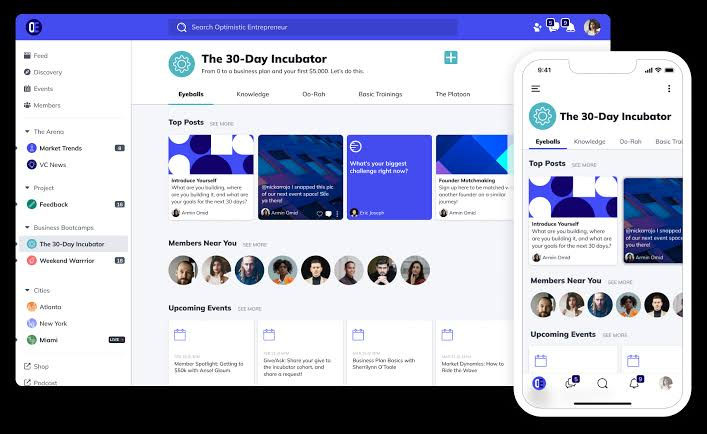
Mighty Networks launched in 2017, founded by Gina Bianchini (who previously built Ning). The entire product is organised around getting members to find each other. Its “People Magic” technology surfaces relevant members, shows what two people have in common, and hands them an opening line so they’ll actually start talking.
Courses live inside something called a Space, which is a flexible container that can hold a feed, a chat, an event, a course outline, or all of them at once. The mental model is: you have a community, and a course happens to be one thing inside it.
Big names use it — Tony Robbins, Marie Forleo, TED — and it consistently ranks at the top of G2’s community software category. That reputation is earned.
Kajabi: business first, community as one product type

Kajabi has been around since 2010 and was built to solve a different problem: how does one person turn expertise into revenue without stitching together six tools?
The answer is a platform where your website, landing pages, funnels, email marketing, automations, checkout, and analytics all live in the same place and talk to each other. Community is a feature in that lineup — strengthened considerably after Kajabi acquired Vibely in 2022, which brought points, badges, challenges, and leaderboards — but it isn’t the centre of gravity.
Feature by feature
1. Community and engagement
Mighty Networks wins here. No point pretending otherwise.

The difference isn’t the feature list — it’s the engineering behind engagement. From the moment someone joins, Mighty Networks is nudging them toward other members. You can see who’s online right now. The People Explorer sorts members by interest and surfaces “members near you” or “top members.” Open someone’s profile and AI shows you your overlap and offers a conversation starter.
It also has native livestreaming built into the product, with up to nine simultaneous speakers and a running side chat. That’s not a Zoom embed — it’s part of the platform.
Kajabi’s community gives you Circles for organising discussions, plus challenges, meetups, live rooms, direct messages, and a member directory. As a private alternative to a Facebook group attached to your course, it does the job well. As a standalone social network designed to manufacture connections between strangers, it isn’t in the same tier.
If you’re selling access to a room full of people, that gap matters a lot. If you’re selling a course and want a place for students to ask questions, it matters much less.
2. Gamification
Kajabi wins. Points, badges, challenges, and leaderboards are all configurable at a level of detail Mighty Networks doesn’t match. You can attach points to specific behaviours and set rules like “when a member hits 100 points, automatically unlock access to this group.”
Mighty Networks has added points, streaks, challenge templates, and a habit tracker, plus a built-in member referral program. Useful, but coarser.
3. Courses
Kajabi wins. Modules and submodules, content locking so students move through in order, drip scheduling, video, audio, downloads — plus graded quizzes with pass requirements and automatic completion certificates.
The bigger advantage is what happens around the course. Because the automation engine sits in the same platform, you can trigger a congratulations email on lesson completion, move a student into a new segment when they finish, or present an upsell automatically. You also get per-student engagement reports, video retention graphs, and heat maps.
Mighty Networks is not weak here — it does on-demand, cohort-based, and live courses, quizzes and tests, automatic badges and certifications, sequential and dripped content, and SCORM-compliant embeds. Its cohort and live-teaching support is arguably more natural than Kajabi’s. But on learning analytics and post-completion automation, Kajabi is ahead.
4. Email marketing, funnels, and automation
This one isn’t close.

Every Kajabi plan includes unlimited marketing emails, unlimited landing pages, and unlimited funnels. Segmentation, behaviour-triggered sequences, drip campaigns, a drag-and-drop email builder, broadcasts — all standard, all connected to what people do inside your products.
Mighty Networks has no email marketing. It sends notifications, and it has a deep Kit integration, but broadcasting to your list means paying for another tool. Zapier access and APIs only start on the Scale plan at $179/mo.
So when you price Mighty Networks, add an email platform to the line item. That’s not a knock on the product — it was never trying to be an email tool — but it changes the comparison.
5. Payments and transaction fees
This is where the sticker price stops telling the truth.
Mighty Networks charges a platform transaction fee on every plan, permanently: 2% on Launch, 1% on Scale, 0.5% on Growth and Mighty Pro. That sits on top of Stripe’s own processing fees. It never reaches zero, no matter how much you scale.
Kajabi takes no revenue share when you use Kajabi Payments. You pay processing (2.9% + $0.30 on Basic, 2.8% + $0.30 on Growth, 2.7% + $0.30 on Pro for US entities — rates vary by country) and nothing else. Kajabi Payments is available for businesses registered in the US, Canada, Australia, the UAE, the UK, and selected European countries.
One caveat worth knowing: if Kajabi Payments is available in your country and you choose to keep your own Stripe account instead, Kajabi adds a third-party payment provider fee of 2% on Basic, 1% on Growth, or 0.5% on Pro. PayPal is exempt. So in practice, using Kajabi Payments is what keeps your fee at zero.
6. Mobile apps
Depends what you need.
Mighty Networks has the cleaner standard app. Courses, community, events, and messaging all live in one app, with the same interface and the same features as the web version. Members install one thing and they’re done. Mighty Pro then offers fully white-labelled apps in the App Store and Google Play, with a team behind the launch — over 400 brands have used it since 2017. It’s a mature offering, but Mighty Pro is custom-priced, which means a sales call and a quote.
Kajabi splits things across a customer app and a separate creator app, which is less elegant. But the branded mobile app is included on the Growth plan ($199/mo annual) and above, listed on Kajabi’s own pricing page at a $199/mo value. Getting a branded app inside a published monthly price, with no negotiation, is a real practical advantage if a branded app is on your roadmap but not your entire strategy.
7. Analytics
Kajabi has the edge. Revenue, page views, conversions, email performance, student progress, and video retention are all available across plans, with Google Analytics integration.
Mighty Insights is genuinely good at what it measures — community engagement, member behaviour, content performance — but Google Analytics integration and marketing pixel tracking require Scale or above.
8. AI features
Different bets.
Kajabi’s AI points at running the business: Cofounder helps you build products, offers, sales pages, and email sequences; Expert Agents and the Kajabi MCP server extend that further. AI credits are allocated by plan (0 on Basic, 500 on Growth, 1,000 on Pro), with top-ups available.
Mighty Networks’ AI points at running the community: AI Cohost can build a community from a one-line description, AI generates member profiles and surfaces connections, and the Infinite Question Engine schedules discussion prompts so conversation continues when you’re offline.
Neither is obviously better — they’re solving different problems. If your bottleneck is “nobody’s talking,” Mighty’s approach helps more. If your bottleneck is “I haven’t launched anything,” Kajabi’s does.
Pricing
Kajabi (September 2026, from the official pricing page)
| Basic | Growth | Pro | |
|---|---|---|---|
| Annual billing | $143/mo | $199/mo | $399/mo |
| Monthly billing | $179/mo | $249/mo | $499/mo |
| Products | 5 | 50 | Unlimited |
| Contacts | 2,500 | 25,000 | 100,000 |
| Communities | 1 | 1 | 3 |
| Websites | 1 | 1 | 3 |
| Admin users | 2 | 11 | 26 |
| Emails / landing pages / funnels | Unlimited | Unlimited | Unlimited |
| Branded mobile app | — | Included | Included |
| Affiliate programs | — | Included | Included |
| Advanced automations | — | Included | Included |
| Kajabi Payments rate (US) | 2.9% + $0.30 | 2.8% + $0.30 | 2.7% + $0.30 |
| Platform revenue share | 0% | 0% | 0% |
Mighty Networks (September 2026, from the official pricing page)
| Launch | Scale | Growth | Mighty Pro | |
|---|---|---|---|---|
| Annual billing | $79/mo | $179/mo | $354/mo | Custom quote |
| Members | Unlimited | Unlimited | Unlimited | Unlimited |
| Hosts / moderators | 3 / 10 | 5 / 15 | 10 / 100 | Unlimited |
| Storage | 200 GB | 500 GB | 1 TB | 4 TB |
| Streaming hours/mo | 20 | 30 | 40 | 50 |
| Viewers per stream | 100 | 200 | 1,000 | 3,000 |
| Zapier / API access | — | Included | Included | Included |
| Branded apps | — | — | — | Included |
| Transaction fee | 2% | 1% | 0.5% | 0.5% |
Neither platform has a permanently free tier. Mighty Networks offers a 14-day trial on the Growth plan with no credit card required. Kajabi’s standard trial is 14 days — the link on this page extends that to 30.
What it actually costs
Monthly price is only part of the picture. Here’s the same business on both platforms.
At $3,300/month in sales:
| Mighty Networks Launch | Kajabi Basic | |
|---|---|---|
| Plan | $79 | $143 |
| Platform fee | 2% = $66 | $0 |
| Email tool | Separate ($29+) | Included |
| Total | ~$174+ | ~$143 |
At $10,000/month in sales:
| MN Launch | MN Scale | Kajabi Basic | |
|---|---|---|---|
| Plan | $79 | $179 | $143 |
| Platform fee | 2% = $200 | 1% = $100 | $0 |
| Email tool | Separate | Separate | Included |
| Total | ~$279+ | ~$279+ | ~$143 |
Card processing applies on both platforms and isn’t included above, since the rates are broadly comparable.
The structural point: Mighty Networks gets more expensive as you succeed. Its fee is a percentage of revenue that never disappears, and moving up a tier to cut the percentage costs roughly what the percentage was saving you — notice how Launch and Scale land at the same total at $10,000/month. Kajabi’s cost is flat, so the effective rate you’re paying falls as you grow.
When Kajabi is the right call
- You’re selling courses, coaching, memberships, or digital products as a business
- You want email marketing and funnels in the same system as your products
- You’d rather not hand over a slice of every sale, permanently
- Quizzes, pass marks, and completion certificates matter to your delivery
- You want a branded app without a custom quote and a sales cycle
- You’re trying to consolidate tools, not add another one
When Mighty Networks is the right call
- Member-to-member interaction is the actual product
- You run cohort-based or live-taught programs as your primary format
- You already have an email platform you’re happy with (especially Kit)
- Native livestreaming with multiple speakers is central to how you deliver
- You’re committed to a fully white-labelled app and have the budget for Mighty Pro
- You’re adding a community layer to a business that already exists elsewhere
Use-case shortlist
| What you’re building | Better fit | Why |
|---|---|---|
| Course business with marketing attached | Kajabi | Email, funnels, and automation are built in |
| Paid community where people come for each other | Mighty Networks | People Magic is genuinely differentiated |
| Coaching practice with a client portal | Kajabi | Coaching product type, scheduling, and payments included |
| Cohort-based program with live teaching | Mighty Networks | Native livestreaming and cohort Spaces |
| Membership with recurring revenue and upsells | Kajabi | Offers, order bumps, and automation in one place |
| Adding community to an existing business | Mighty Networks | Cheap entry, unlimited members, no rebuild required |
| Scaling past ~$10k/month in platform sales | Kajabi | Flat cost instead of a permanent revenue share |
| Branded app on a published price | Kajabi | Included on Growth and above |
Common misconceptions
“Mighty Networks is cheaper”
At the sticker level, yes — $79 versus $143. But add the permanent transaction fee and the email platform you’ll need anyway, and the totals flip at fairly modest revenue. The gap then widens the more you sell.
“Kajabi’s community is just a forum”
It was, once. Post-Vibely it has Circles, challenges, live rooms, DMs, member directories, and the most granular gamification system of any platform in this category. What it doesn’t have is Mighty’s matchmaking engine. For a community attached to a course, that’s usually fine. For a community as the product, it’s a real limitation — and worth being honest about.
“Kajabi has no transaction fees at all”
Close, but stated too loosely. Kajabi takes no revenue share when you use Kajabi Payments. If Kajabi Payments is offered in your country and you insist on keeping your own Stripe account, you’ll pay 2% / 1% / 0.5% depending on your plan. Plan for Kajabi Payments and the number is zero.
“Mighty Networks can replace my whole stack”
It can replace your community tool and your course tool. It can’t replace your email platform, your funnel builder, or your website. Budget accordingly.
Decision checklist
Choose Kajabi if:
- Selling is as important as delivering
- You want email, funnels, and automation in the same system
- A permanent cut of revenue is a dealbreaker
- You need certificates, graded quizzes, or detailed learner analytics
- You want a branded app without a custom quote
Choose Mighty Networks if:
- Connection between members is the core value you’re selling
- You teach live or in cohorts more than on demand
- You already have email and marketing handled elsewhere
- Native livestreaming is central to your delivery
- You’re going all-in on a white-labelled app
Get 30 days free instead of 14
Kajabi’s standard free trial is 14 days. Starting through the link on this page extends that to 30 days, at no extra cost and with no difference in features.
Two weeks is enough to click around. Thirty days is enough to actually build something — import your content, set up a product, wire up a checkout, send a real email sequence, and see whether the platform fits the way you work. That’s the test that matters, and it’s hard to run in 14 days alongside everything else you’re doing.
The bottom line
Mighty Networks is a very good product at the thing it’s designed for. If your business is a room full of people who are there for each other, its engagement engine, native livestreaming, and unified mobile app are hard to beat, and Kajabi doesn’t have an equivalent.
But most people asking this question aren’t building that. They’re building a course, a membership, or a coaching practice, and they need the surrounding machinery — pages, email, funnels, automation, checkout, analytics — to work without being assembled by hand. That’s the job Kajabi was built for, and it does it in one system rather than five.
Add the economics and the case gets clearer. Kajabi’s cost is flat, with no revenue share when you use Kajabi Payments. Mighty Networks charges a percentage of everything you sell, forever, and you’ll be paying for an email platform on top of it. At $3,000/month in sales that difference is modest. At $10,000 it’s substantial. At $50,000 it’s not really a debate.
Both offer free trials. If you want the version of that test that’s long enough to be useful, start Kajabi through the link on this page and take the 30 days.
Pricing and feature details in this article were taken from the official Kajabi and Mighty Networks pricing pages and help centres in September 2026. Both platforms update their plans regularly, so confirm current terms before you commit.

